
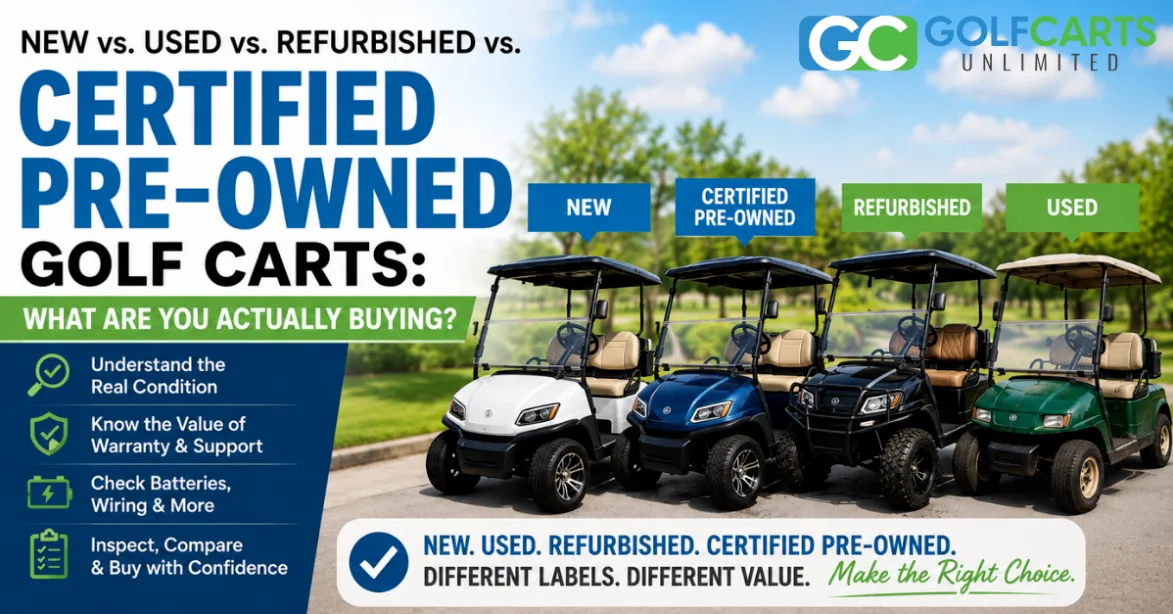
New vs. Used vs. Refurbished vs. Certified Pre-Owned Golf Carts: What Are You Actually Buying?
You find two golf carts that look almost identical.
Same brand. Similar year. Similar seats, wheels, tires and accessories.
One costs considerably less than the other.
So which one is the better deal?
Maybe the cheaper one.
There are good deals on used golf carts everywhere—from dealers, private sellers and online marketplaces. A higher price doesn’t automatically mean a better cart, and a lower price doesn’t automatically mean there’s something wrong with it.
The bigger question is:
What are you actually getting for your money?
At GolfCarts Unlimited, that’s something we encourage customers to look beyond the price tag to understand.
New, used, refurbished and Certified Pre-Owned golf carts can all make sense. But those terms don’t necessarily mean the same thing, and two carts that look nearly identical can have very different histories and conditions.
Let’s break down what you should know.
What Do You Get When You Buy a New Golf Cart?
New is the easiest category to understand.
You’re starting with a new vehicle rather than trying to determine how a previous owner drove, stored or maintained it.
You’re also receiving the applicable manufacturer’s new-vehicle warranty.
For some customers, that peace of mind is worth paying for.
You may also want the newest body style, technology, lithium system, accessories or other features offered on current models.
But buying new isn’t automatically the best decision for everybody.
If you’re more concerned about value than having the newest model, a properly inspected used or Certified Pre-Owned cart may give you everything you need for less money.
That’s why we sell both.
What Does “Used” Really Tell You?
Not much—other than somebody owned the cart before you.
There are excellent used golf carts.
There are neglected used golf carts.
And there are plenty somewhere in between.
The important part is the cart’s condition, history and how it was maintained.
A five-year-old golf cart that was properly maintained may be a much better purchase than a newer cart that was neglected or poorly modified.
That’s why we don’t think mileage, model year or appearance should be considered by themselves.
We want to know what’s actually going on with the cart.
What Should Be Checked on a Used Golf Cart?
Golf carts are relatively simple vehicles compared with automobiles, but that doesn’t mean there’s nothing to inspect.
They still have steering, suspension, brakes, bearings and electrical components. Depending on the cart, there may also be batteries, a motor and controller, or a gas engine and related components.
Then there’s everything that may have been added after the cart left the factory.
Lights.
Rear seats.
Lift kits.
Sound systems.
USB ports.
Custom switches.
LED lighting.
Performance upgrades.
Who installed those items, and how were they installed?
When we inspect a used cart, we’re interested in much more than whether it starts and makes it around the parking lot.
That’s also why putting a cart on a lift can tell us things that aren’t obvious when you’re standing next to a freshly detailed cart.
What Does “Refurbished” or “Reconditioned” Mean?
This is where things get interesting.
Ask the seller what they mean by refurbished.
There isn’t one universal level of work that every seller necessarily performs simply because a cart is described that way.
One seller’s refurbished cart might have undergone substantial mechanical and cosmetic work.
Another may have received a new body, seats, wheels, tires, rear seat, lift kit and lights.
That second cart may look brand new.
And there isn’t anything wrong with cosmetic upgrades.
The question is whether you’re assuming that everything underneath the new cosmetics was also inspected or replaced.
Don’t assume.
Ask.
What was inspected?
What was replaced?
Were the brakes and suspension checked?
What condition are the batteries in?
Was the electrical system inspected?
Was aftermarket wiring cleaned up or corrected where necessary?
If a seller can explain what was actually done to the cart, you can make a much more meaningful comparison.
Is a Refurbished Golf Cart the Same as Certified Pre-Owned?
Not necessarily.
This is an important distinction.
“Refurbished” or “reconditioned” can describe work performed on a used golf cart by a dealer, rebuilder or seller.
A manufacturer-backed Certified Pre-Owned program, when offered, has requirements established by that manufacturer.
Depending on the particular program, that may include specified inspection or reconditioning requirements and particular warranty coverage.
So if you’re comparing a cart advertised as refurbished with a Certified Pre-Owned cart, don’t compare the labels alone.
Ask:
Who certified it?
What did the certification process require?
What was inspected or replaced?
What warranty comes with it?
That’s how you determine what “Certified Pre-Owned” actually adds to that particular cart.
Can a Refurbished Cart Still Be a Great Buy?
Absolutely.
The word itself isn’t the problem.
We simply want customers to understand what they’re buying.
If somebody properly inspects a used cart, replaces worn components, addresses mechanical issues, installs quality accessories and stands behind the work, that refurbished cart could be an excellent purchase.
The same applies to a good private-party used cart.
Condition matters more than terminology.
That’s one of the biggest takeaways from this entire article.
What About the Batteries?
On an electric used or refurbished cart, batteries can represent a significant part of the value.
Don’t stop at:
“It has new batteries.”
Ask what batteries were installed and when.
If they’re flooded lead-acid, consider their age, condition and maintenance history.
If they’re lithium, find out what battery system is installed, its age, applicable warranty and who supports it.
A cart with an inexpensive replacement battery setup isn’t necessarily equivalent to another cart simply because both listings say “new batteries.”
If you’re trying to understand which battery technology makes sense for your use, we’ve covered that in our Lithium vs. Lead-Acid Golf Cart Batteries guide.
Does Aftermarket Work Matter?
Very much.
Some used carts have been modified by experienced professionals.
Others have been worked on by several owners over many years.
We’ve seen wiring that was clean, protected and properly installed.
We’ve also seen wiring where you start following one accessory and wonder exactly what happened along the way.
That’s why we look at how accessories are connected and routed—not simply whether they turn on.
The same idea applies to lift kits, suspension modifications and performance upgrades.
An accessory being present doesn’t tell you whether it was installed properly.
What If You’re Buying From a Private Seller?
There can be some excellent private-party deals.
If you find a cart that appears to be a good value, go look at it.
Drive it.
Ask questions.
Look for service records if they’re available.
And if you’re making a significant investment and aren’t comfortable evaluating the cart yourself, consider asking whether you can pay to have it professionally inspected before completing the purchase.
Maybe the inspection comes back clean and confirms that you found a great cart at a great price.
That’s a win.
The point isn’t to avoid private sales.
It’s to make the purchase with as much information as possible.
Make Sure the Cart Is Actually What It’s Advertised As
This is one area people sometimes overlook.
We’ve had privately purchased golf carts come into our shop where the customer later discovered the model year or even model generation wasn’t what they thought they had purchased.
That doesn’t necessarily mean the seller intentionally misrepresented it. Sometimes people simply don’t know exactly what they own.
Either way, verify it yourself.
Find the serial number and use the appropriate manufacturer information to help identify the cart.
Know where the identification should be located on that particular make and model.
If identification appears to be missing or intentionally altered, that’s a reason to stop and investigate further before purchasing.
We’ve actually had a cart brought into our shop after being purchased through Marketplace that turned out to have previously been stolen. The buyer believed he’d found a good deal and had no idea there was an issue when he purchased it.
That’s an unusual situation, but it illustrates why identification matters.
Verify the condition of the cart—and verify the cart itself.
Why Can Two Similar-Looking Used Carts Have Very Different Prices?
This brings us back to where we started.
Imagine one cart is $3,000 less than another.
Maybe it really is the better deal.
But first make sure you’re comparing more than:
Year.
Paint.
Seats.
Wheels.
Rear seat.
Lights.
Those are the things you can see in photographs.
What you can’t necessarily see is how much inspection, repair and preparation went into each cart.
At GolfCarts Unlimited, our used carts are inspected before they’re put out for sale. We put them on a lift, look at the mechanical and electrical condition, and address items as necessary.
We also pay attention to how accessories are installed and how wiring is routed and protected.
That work involves parts, labor and experienced technicians.
Another seller may have done just as much.
Or they may have done less.
Ask them.
That’s the only way to make a fair comparison.
What Are You Getting After You Buy It?
This is another part of the price that isn’t visible in a photograph.
With a typical private-party sale, once the transaction is complete, future repairs generally become the new owner’s responsibility.
Some buyers are perfectly comfortable with that.
Maybe you work on your own carts. Maybe the purchase price is good enough that you’re willing to accept that tradeoff.
When purchasing from a dealer, find out what support actually comes with the cart.
Is there a warranty?
Who performs warranty repairs?
Does the dealer have a service department?
Can they obtain parts?
Do they have diagnostic equipment for that brand?
What happens if something goes wrong?
Those are questions we’d recommend asking any dealer—including us.
At GolfCarts Unlimited, the carts we sell with warranty coverage are backed according to the applicable warranty terms, and we have our own service operation to support the products we sell.
That’s part of the value of the cart.
Whether that additional value is worth paying for is ultimately up to you.
Does Buying New Mean You Won’t Have Problems?
No.
And we think that’s worth saying.
New golf carts can have problems too.
They’re machines with moving parts and electrical components. Things can eventually fail regardless of whether a cart started life in your garage or belonged to someone else first.
A warranty doesn’t mean a problem can never happen.
It means you should understand what support you have if one does.
The same thinking applies to used and Certified Pre-Owned carts.
Which One Should You Buy?
This is where we come back to the same philosophy we use when helping someone choose a golf cart in the first place.
It depends on what matters to you.
New may make sense if:
You want the newest model and features, a completely known history and applicable new-vehicle manufacturer warranty coverage.
Certified Pre-Owned may make sense if:
You want a used cart backed by an applicable manufacturer’s established certification program and the benefits included with that particular program.
Refurbished or dealer-inspected used may make sense if:
You want to save money compared with new while buying a cart that has had inspection, repair or reconditioning work performed. Just find out exactly what was done and what support comes afterward.
Private-party used may make sense if:
You find the right cart at the right price, verify what you’re buying and are comfortable with the condition and whatever responsibility you’ll assume after the purchase.
Another important decision is whether a gas or electric golf cart better fits the way you plan to use it.
There can be great buys in every one of those categories.
If you’re still deciding what type of cart fits your needs, start with our guide to choosing the right golf cart for personal transportation.
The Label Matters Less Than What’s Behind It
Don’t buy a cart simply because someone called it refurbished.
Don’t buy one simply because it says Certified Pre-Owned without understanding the particular certification program.
Don’t assume a used cart is a bad purchase.
And don’t assume new is automatically the best value.
Ask questions.
Look at the cart.
Understand its history when possible.
Find out what has been inspected or replaced.
Understand the battery system.
Verify the year and model.
Know what warranty or support you’re receiving.
Then compare prices.
At GolfCarts Unlimited, we’re happy to explain what has gone into one of our carts so you can make that comparison for yourself.
Because the goal isn’t necessarily to buy the cheapest cart or the most expensive one.
It’s to understand:
What am I actually getting for my money?
Used-cart condition, inspection procedures, certification requirements, warranty coverage and included services vary by vehicle, seller, manufacturer and program. Verify the specific vehicle, applicable warranty terms and program requirements before purchasing.