
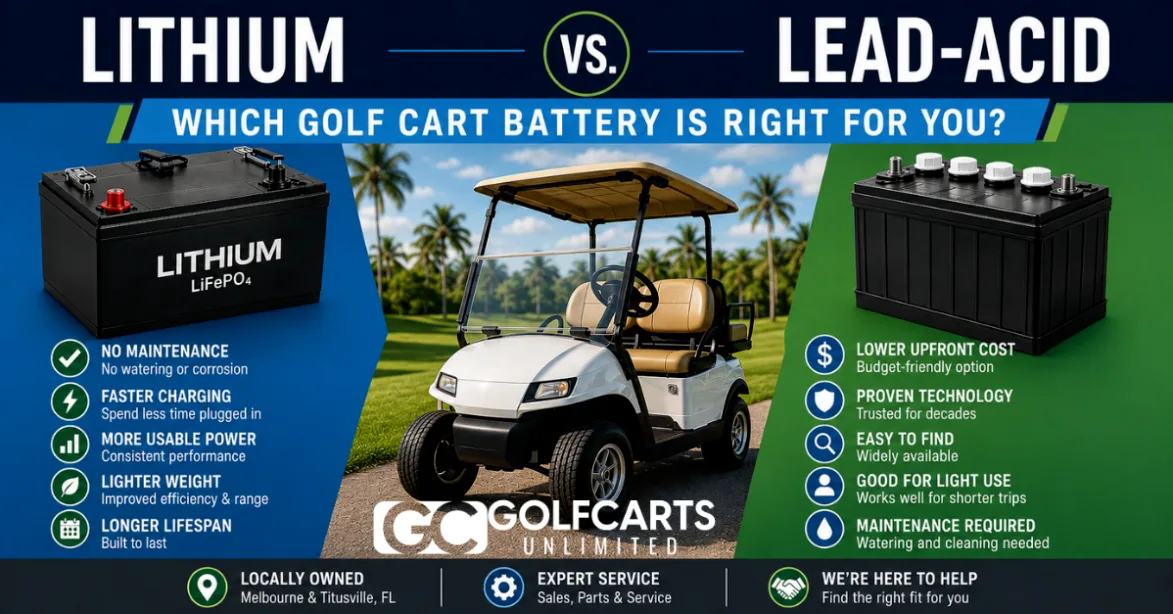
Lithium vs. Lead-Acid Golf Cart Batteries: Which Should You Choose?
So, you’ve decided an electric golf cart makes sense for you over a gas golf cart.
Now there’s another decision to make:
Lithium or flooded lead-acid batteries?
It’s easy to research this question online and come away thinking lithium is automatically the better choice because it’s newer technology.
We don’t look at it that way.
At GolfCarts Unlimited, we would rather understand how you’re going to use and maintain your golf cart before recommending that you spend additional money on a battery system you may not need.
For some customers, we absolutely recommend lithium.
For others, we’ll tell them to save their money and stick with flooded lead-acid.
Here’s how we look at the decision.
Is Lithium Worth the Extra Money?
Sometimes.
But not for everybody.
Let’s say you’re comparing two similar electric golf carts. The cart with flooded lead-acid batteries costs less upfront, while the lithium-equipped cart requires you to spend more.
If keeping the initial purchase price down is important, there’s nothing wrong with choosing flooded lead-acid.
Use those batteries. Maintain them properly. Get the useful life you can out of them.
When they eventually need replacement, you can decide whether you want another set of flooded lead-acid batteries or whether converting to lithium makes sense for that particular cart.
A lot can happen between now and then.
Lithium technology may continue improving. Pricing may change. New battery options may become available.
You might even decide several years from now that you want a completely different golf cart.
Why spend extra money today simply because somebody told you that you have to have lithium?
You don’t.
Battery type and condition are also important when comparing new, used, refurbished and Certified Pre-Owned golf carts.
When Would We Tell Someone to Save the Money and Buy Lead-Acid?
Here’s a good example.
A customer tells us:
“I’ve owned golf carts with lead-acid batteries before. I know how to maintain them. I’ve never had a problem with the range, and adding water doesn’t bother me.”
Our response isn’t going to be:
“You still need lithium.”
Why?
What problem would we be solving?
That customer already understands what they’re buying. They know the maintenance involved. They’re comfortable with the charging routine. They know what to expect as those batteries age.
Most importantly, they’re getting enough range for the way they use the cart.
In that situation, we may recommend keeping the extra money in your pocket and going with flooded lead-acid.
We’re not going to push somebody into a more expensive battery just because it’s newer technology.
So Why Do People Spend More for Lithium?
Because for the right customer, lithium solves some very real problems.
One of the biggest is maintenance.
Flooded lead-acid batteries require you to monitor and maintain the electrolyte level. Lithium golf-cart batteries don’t require that regular watering. Manufacturer guidance for flooded batteries specifically calls for periodic water checks and proper watering procedures.
For someone who has maintained flooded batteries for years, that may not sound like a big deal.
For someone who knows they’re probably not going to check the water?
That’s a different story.
We’d rather have that conversation before you buy the cart than see you later with batteries that haven’t been maintained properly.
What Happens If You Don’t Maintain the Water?
This is something we see in the real world.
Some owners simply forget about the batteries.
They drive the cart.
They charge it.
They keep driving it.
But nobody checks the water.
If the electrolyte level gets too low and the plates become exposed, battery performance and life can be affected. Battery manufacturers specifically warn against allowing the plates to become exposed.
Then there’s the opposite problem.
People add too much water.
We see that too.
Some owners assume filling the battery all the way to the top must be better.
It isn’t.
The electrolyte level changes during charging, which is why flooded-battery manufacturers generally instruct owners to do their final watering after the batteries are fully charged. Overfilling can lead to overflow and a corrosive mess around the battery compartment.
Flooded lead-acid batteries aren’t necessarily difficult to own.
But they do require you to pay attention to them.
If you already know how and don’t mind doing it, great.
If you’re reading this thinking, There is absolutely no way I’m going to remember to check battery water, lithium deserves a serious look.
What About the Mess Around Lead-Acid Batteries?
This is another reason some customers prefer lithium.
A lot of personal transportation carts spend their lives parked and charged inside nice garages.
With flooded lead-acid batteries, improper watering or maintenance can contribute to acid residue and corrosion around batteries, terminals and the battery compartment. Manufacturers recommend keeping these areas clean and dry and addressing corrosion when it occurs.
If avoiding that type of maintenance is important to you, lithium may be worth the additional cost.
It’s not always about getting more miles.
Sometimes you’re paying for convenience and a simpler ownership experience.
Does Lithium Give You More Range?
This is where we have to be careful with the question.
The range of an electric golf cart depends on the actual battery system, its capacity, the cart, passenger load, terrain, driving style and other conditions.
So we don’t automatically tell somebody:
“Lithium means more range.”
Instead, we ask:
“How far do you actually need to go?”
If you’re driving six or eight miles on a typical day and your flooded lead-acid system comfortably handles that, paying for additional capacity may not provide much practical value.
If you’re regularly pushing the limits of your existing setup, then we need to start comparing specific battery capacities and systems.
That’s when lithium may become much more attractive.
What About High-Performance Golf Carts?
There’s another situation where battery selection becomes especially important.
Some owners want significant performance upgrades.
Maybe they’re installing a higher-output motor or controller and building a cart with electrical demands well beyond a stock personal transportation vehicle.
In that situation, the battery system needs to be capable of supplying what the rest of the electrical system requires.
Some lithium systems are specifically designed to support higher-current applications, but that doesn’t mean every lithium battery is appropriate for every modified cart. Battery manufacturers themselves specify different packs for different controller/current demands.
The battery, BMS, controller, motor, charger and overall electrical system all need to be considered together.
This is one area where we don’t recommend choosing a battery based solely on voltage and advertised range.
Are All Lithium Golf Cart Batteries the Same?
No.
And this is one of the biggest things we want customers to understand.
Two lithium batteries can look similar from the outside and be very different systems.
The cells matter.
The internal wiring and connections matter.
The current capability matters.
Manufacturer support matters.
And one of the most important pieces of the system is the Battery Management System, usually called the BMS.
When customers see an inexpensive lithium battery online and another one that costs considerably more, it’s tempting to compare only voltage, amp-hours, advertised range and warranty.
Those numbers don’t tell the whole story.
What Does the BMS Actually Do?
Without getting overly technical, the BMS helps monitor and manage the lithium battery.
Depending on the particular system, it can monitor conditions such as voltage, temperature, current, charging and discharging. Some systems can respond when operating conditions move outside their designed limits.
That’s why we care about more than the cells themselves.
We want to know:
Who built the battery?
What is the battery designed to handle?
What kind of manufacturer support is available?
What happens if there’s a problem?
Can the system be diagnosed or updated if necessary?
Will someone be there to support the product several years from now?
A battery is a major component of your golf cart.
We think it’s worth knowing what you’re buying.
Why Is One Lithium Battery So Much Cheaper Than Another?
That’s a question worth asking.
Lower price doesn’t automatically mean a bad battery.
And higher price doesn’t automatically guarantee a better one.
But when there’s a substantial price difference between two battery systems, we want to understand what you’re getting for the money.
What current is the battery designed to handle?
What type of warranty comes with it?
Who actually handles that warranty?
Can we get technical support?
Does the manufacturer have a history in the golf-cart market?
What happens several years down the road if the battery needs service?
For GolfCarts Unlimited, support after the sale matters just as much as what’s printed on the battery label.
How Long Do Lead-Acid Golf Cart Batteries Last?
This is another question where we’d rather not promise an exact number.
In our experience, flooded lead-acid golf-cart batteries can provide several years of useful service when they’re properly charged, watered and maintained.
But lifespan can vary significantly.
How often the cart is driven matters.
How deeply the batteries are discharged matters.
Charging habits matter.
Water levels matter.
Storage matters.
Florida heat can matter too; battery manufacturers note that higher temperatures accelerate self-discharge and can negatively affect battery life.
So rather than telling somebody:
“These batteries will last exactly X years,”
we’d rather explain how to take care of them and help you get as much useful life from them as possible.
Does Lithium Last Longer?
Lithium systems are generally sold with the expectation of longer service life than traditional flooded lead-acid systems, but we’re still not going to promise that every lithium battery will last a certain number of years.
Different batteries have different designs, warranties, capacities and operating requirements.
How the battery is used and stored matters too.
That’s another reason we put so much importance on the manufacturer and warranty behind the battery.
If you’re spending additional money because you expect to keep that battery for a long time, support several years from now matters.
What If You Leave Florida for Several Months?
This is especially relevant to seasonal Florida residents.
We’ve had customers leave flooded lead-acid carts sitting for months and return to batteries that have discharged to the point where getting the cart charging normally again requires additional attention.
Battery manufacturers specifically warn against leaving lead-acid batteries sitting at a low state of charge for extended periods and recommend monitoring and recharging them during storage.
If you’re leaving for several months, tell us.
We want to know how the cart will be stored and what battery system is in it.
Lithium batteries have storage procedures too, and those procedures can vary by manufacturer and battery model. Some systems have dedicated storage modes and specific state-of-charge recommendations.
So whether you have lead-acid or lithium, don’t assume the best storage plan is simply:
Park it and forget about it.
Follow the instructions for the battery that’s actually in your cart.
Can You Buy Lead-Acid Now and Switch to Lithium Later?
Depending on the cart and electrical system, a lithium conversion may be possible later.
And for a budget-conscious customer, we think that’s worth considering.
Suppose the cart you really want is available with flooded lead-acid batteries, but moving to lithium today stretches the purchase beyond what you’re comfortable spending.
You don’t necessarily have to give up the cart.
Buy it with lead-acid.
Maintain the batteries.
Enjoy the cart.
When those batteries eventually reach the end of their useful life, evaluate your options again.
Maybe converting that cart to lithium will make sense.
Maybe battery technology or pricing will have changed.
Maybe you’ll decide you want a newer cart instead.
The important thing is that a future conversion should be evaluated for the specific golf cart, charger and electrical system rather than assuming every cart can simply have its batteries swapped.
You don’t have to make every future decision on the day you buy the golf cart.
Who Should Seriously Consider Lithium?
Lithium starts making a lot of sense when a customer tells us things like:
“I don’t want to maintain battery water.”
“I want to avoid the maintenance and residue associated with flooded batteries.”
“I need a battery system with more usable capacity for the amount I drive.”
“My cart gets used heavily throughout the day.”
“I’m building a performance cart with higher electrical demands.”
“I’m willing to spend more upfront for a simpler battery-maintenance experience.”
Those are good reasons to have a serious lithium conversation.
Not because lithium is newer.
Because it solves something that matters to that customer.
Who May Be Perfectly Happy With Lead-Acid?
On the other hand, flooded lead-acid may be a perfectly sensible choice if you tell us:
“I’ve owned them before.”
“I know how to maintain them.”
“Checking the water doesn’t bother me.”
“The range has always been enough for what I do.”
“I’m trying to keep my upfront purchase price down.”
In that situation, we’re not going to manufacture a reason for you to spend more money.
If lead-acid does everything you need it to do and you’re comfortable maintaining it:
Save the money.
That’s a recommendation we’re perfectly comfortable making.
So, Is Lithium Better Than Lead-Acid?
We think there’s a better question:
“What am I getting for the additional money, and do I actually need it?”
Depending on the particular system, lithium can offer advantages that may matter to you—especially reduced routine battery maintenance, different capacity and performance options, and suitability for certain higher-demand applications.
But an advantage only has value if it solves something for you.
If you already know how to maintain flooded lead-acid batteries, don’t mind doing it, and they provide all the range you need, paying more for lithium may not solve a problem you actually have.
If you hate battery maintenance, need a different capacity or performance capability, or simply value the convenience enough to pay for it, lithium can be money well spent.
Don’t Buy a Battery Based on the Label
Whether you’re choosing flooded lead-acid or lithium, don’t make the decision solely on the biggest number or the lowest price.
Tell us how you use your golf cart.
How far do you drive?
Where do you store it?
How often is it used?
Will you maintain flooded batteries?
Does the cart sit for months at a time?
Are you planning performance upgrades?
How long do you expect to keep the cart?
Those answers tell us far more than simply saying:
“I want lithium.”
At GolfCarts Unlimited, our goal isn’t to put the most expensive battery in every cart.
It’s to help you spend money where it actually improves your ownership experience.
Visit us in Melbourne or Titusville, tell us how you’re going to use your golf cart, and we’ll help you compare the battery options that make sense for you.
Sometimes that means lithium.
Sometimes it means flooded lead-acid.
The right battery is the one that solves your problem without making you pay for something you don’t need.
Battery performance, range, lifespan, charging, current capability, compatibility, maintenance and storage requirements vary by battery, golf cart, configuration, conditions and use. Follow the applicable golf-cart and battery manufacturers’ specifications, safety instructions and maintenance procedures. Battery conversions or performance modifications should be evaluated for compatibility with the specific vehicle and electrical system.