
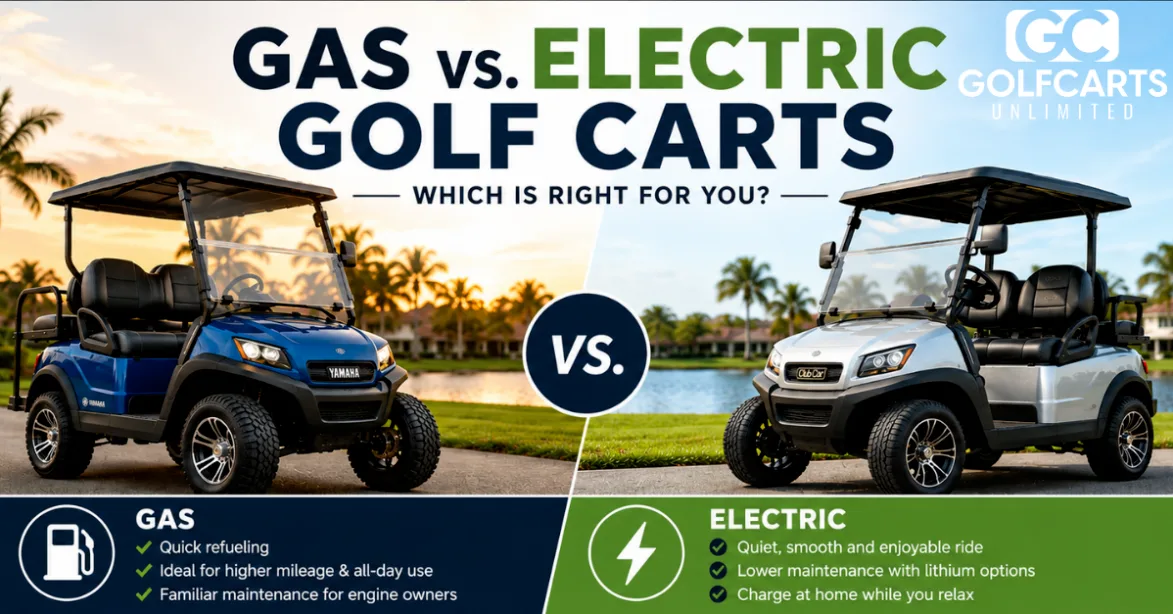
Gas vs. Electric Golf Carts: Which Is Right for You?
“Should I buy a gas or electric golf cart?”
It’s one of the most common questions we hear from customers shopping for a golf cart for personal transportation.
The answer is pretty simple:
Neither one is better for everybody.
Most customers who walk into GolfCarts Unlimited already have an idea of what they want. Some have owned gas carts for years and want another one. Others know before they arrive that they want electric.
Our job isn’t necessarily to change your mind.
It’s to ask enough questions to make sure the cart you think you want actually fits the way you’re going to use it.
How far will you drive? Where will you keep the cart? Who will use it? Do you have a convenient place to charge? Will it sit unused for months at a time?
Once we know those things, gas versus electric usually becomes a much easier decision.
How Far Do You Actually Drive in a Day?
Range is one of the biggest concerns we hear from customers considering electric.
But there’s an important difference between asking:
“How far can this golf cart go?”
and:
“How far do you actually need it to go?”
We’ve talked with customers who were worried about running out of battery. Then we started asking what a normal day looked like.
Maybe they take the cart to the community pool, visit friends, make a grocery run, take the dog for a ride, or go out to dinner.
When we add everything up, sometimes they’re only driving six, seven or eight miles during a typical day.
Suddenly, the range question looks very different.
That doesn’t mean range should be ignored. It means your decision should be based on your actual driving habits, not simply the largest range number you can find online.
Range can vary depending on the cart, battery system, passenger load, terrain, driving conditions and how the vehicle is operated.
We’d rather understand your normal day and make sure you have comfortable usable range than sell you more battery than you actually need.
Where Are You Going to Keep the Golf Cart?
This is one of the first questions we ask, and it tells us more than you might expect.
Is the cart going in a garage?
A shed?
Under a covered area?
Outside?
If you’re considering electric, there’s an immediate follow-up:
Where are you going to charge it?
We’ve worked with customers who planned to use their carts around larger properties where the cart might be parked in different locations. If there isn’t convenient access to power where the cart will be kept, gas can make everyday ownership considerably easier.
You can have a fantastic electric cart, but if charging it becomes an inconvenience every night, it may not be the right cart for your situation.
Will the Cart Actually Fit Where You’re Storing It?
Once we start talking about storage, another issue sometimes comes up.
Customers can fall in love with a lifted cart before measuring the garage door, shed opening, trailer or toy hauler where they plan to keep it.
If clearance is tight, there are options.
Sometimes smaller tires provide enough additional room. In other situations, a non-lifted cart simply makes more sense.
There are also kits that allow the top to be lowered while the cart is being stored or transported. We’ve installed these for customers who wanted a lifted cart but needed additional clearance to fit it into a trailer.
There is a tradeoff: that additional functionality can create a little more rattling while driving, so it isn’t something we automatically recommend to everybody.
Sometimes the simplest solution is the best one:
Buy the cart that fits where you need to put it.
Who Is Going to Remember to Plug It In?
This question gets a few laughs in the showroom, but it matters.
You might be great about plugging in the cart when you’re finished.
But are you the only person driving it?
Maybe your spouse uses it. Maybe your teenagers use it. Maybe several family members are jumping on and off the cart throughout the day.
With an electric cart, someone needs to pay attention to the charge level and make sure it’s ready for the next person.
For some households, that’s easy.
For others, it eventually becomes:
“Who used the golf cart last and forgot to plug it in?”
Gas has a certain simplicity in that situation. If you’re getting low on fuel, you add fuel and keep going.
The question isn’t whether your family can remember to charge an electric cart.
It’s whether that routine fits naturally into the way your family will use it.
Does a Gas Golf Cart Really Require More Maintenance?
We hear this quite a bit:
“I want electric because gas carts require more maintenance.”
There’s some truth behind the idea, but it isn’t the complete picture.
A gas golf cart has an engine, so it has engine-related maintenance such as oil, filters and other manufacturer-recommended service items.
But electric doesn’t automatically mean maintenance-free.
A flooded lead-acid battery system requires regular attention. Water levels need to be maintained correctly, connections should be inspected and kept clean, and charging habits matter.
We’ve seen customers neglect flooded lead-acid batteries until the water level became too low.
We’ve also seen the opposite—owners filling them all the way to the top, which can create a mess when charging causes the fluid level to rise.
So when somebody tells us they want electric because they don’t want maintenance, we want to know:
What type of battery are you considering?
Because flooded lead-acid and lithium provide very different ownership experiences.
Does Lithium Make Electric Easier to Own?
For many customers, yes.
Lithium eliminates the regular battery watering associated with flooded lead-acid systems and can make routine electric-cart ownership considerably simpler.
But there’s another side to the lithium conversation:
Not all lithium batteries are the same.
The Battery Management System, or BMS, matters. Internal components matter. Manufacturer support and warranty coverage matter.
And several years from now, if that battery needs service, support or an update, who stands behind it matters.
That’s why we don’t recommend choosing a lithium battery solely because it’s inexpensive or has an impressive range number on a brochure.
We go much deeper into those differences in our guide to Lithium vs. Lead-Acid Golf Cart Batteries.
What If You Leave Florida for Several Months?
This is especially important for seasonal Florida residents.
If you’re going to leave your golf cart sitting for months at a time, tell us.
We’ve seen flooded lead-acid carts sit unused long enough for the battery voltage to drop so low that the regular charger no longer recognizes the pack and begins charging normally.
At that point, additional service may be necessary to bring the voltage back up.
Repeatedly allowing batteries to sit deeply discharged can also shorten their useful life.
Lithium has different storage considerations, but it still needs to be stored according to the battery manufacturer’s recommendations.
If you’re leaving for several months, we want to know what battery system you have, how the cart will be stored and whether someone will be available to check on it while you’re gone.
When Does Gas Make More Sense?
One of gas’s biggest advantages is simple:
You can refuel and keep driving.
That can be particularly valuable if you put substantial mileage on your cart, use it throughout the day, have multiple people driving it, or don’t have convenient access to charging.
Gas can also make sense on larger properties where the cart may not return to the same parking and charging location every night.
And for some customers, gas is simply familiar. They understand engines, are comfortable with basic mechanical maintenance and like knowing they can add fuel and immediately continue driving.
Those are all legitimate reasons to choose it.
When Does Electric Make More Sense?
Now look at the opposite situation.
You drive relatively short distances.
Your cart comes home to the same garage every evening.
There’s an appropriate charging location right where you park it.
You enjoy quiet rides around the neighborhood.
You’re comfortable plugging it in when needed.
In that situation, electric can make a lot of sense.
And if you choose lithium, much of the regular battery maintenance associated with traditional flooded lead-acid systems is eliminated.
For someone driving a handful of miles around the neighborhood with an easy charging routine, the ability to refill a gas tank in a few minutes may provide very little practical advantage.
That’s why how you use the cart matters more than which powertrain sounds better on paper.
Is a Gas Golf Cart Too Loud?
This is something we encourage customers to experience rather than simply read about.
Gas carts from different manufacturers can feel noticeably different.
Engine noise can be different. Acceleration can be different. Smoothness, suspension and overall ride quality can be different.
We’ve found Yamaha gas carts particularly impressive when it comes to smooth acceleration, noise level and overall ride quality.
But don’t just take our word for it.
Drive one.
Then drive another brand.
Listen to them. Accelerate. Turn. Ride over some uneven pavement.
A short test drive can answer questions that hours of online research won’t.
Electric will still appeal to customers who place a high value on quiet operation. If your favorite use is an evening neighborhood ride while talking with your spouse, friends or family, that quietness may be an important part of the experience.
Other customers simply don’t care about engine noise.
Neither preference is wrong.
Is Gas or Electric Cheaper to Own?
There isn’t one honest answer that applies to everybody.
You have to look at the entire ownership experience.
With gas, consider fuel and engine-related maintenance.
With flooded lead-acid electric, consider electricity, regular battery maintenance and eventual battery replacement.
With lithium, the upfront battery cost is typically higher, but you’re getting a different maintenance profile and potentially a longer service life.
Then consider how much you actually drive.
Someone using a cart for a few miles on weekends has a completely different ownership pattern from someone driving every day.
That’s why we don’t like blanket statements such as:
“Gas is cheaper.”
or:
“Electric is cheaper.”
Give us your actual usage, and then we can have a meaningful conversation about cost.
What Should You Ask Before Choosing Gas or Electric?
If you’re trying to decide, start with these questions:
How many miles will you normally drive in a day?
Where will the cart be stored?
Do you have a convenient place to charge it?
How many people will regularly use the cart?
Will everyone remember to plug it in?
Will the cart sit unused for months at a time?
How important is quiet operation?
Are you comfortable maintaining flooded lead-acid batteries?
Do you value being able to refuel and immediately continue driving?
Are there community restrictions on gas or electric carts where you plan to use it?
Once we know those answers, the decision usually becomes much clearer.
So, Should You Buy a Gas or Electric Golf Cart?
If you’re waiting for us to declare a winner, we’re not going to.
There isn’t one.
If you drive relatively short distances, have a convenient place to charge, enjoy quiet operation and are comfortable with the charging routine, electric may fit your lifestyle extremely well.
If you drive substantial mileage, use the cart throughout the day, don’t have convenient access to charging or value being able to add fuel and immediately continue driving, gas may make more sense.
Sometimes it simply comes down to personal preference.
That’s okay too.
The important thing is understanding the tradeoffs before you spend the money.
Drive Both Before You Decide
You can research gas versus electric golf carts online for hours.
Eventually, though, you need to sit in them.
Come visit GolfCarts Unlimited in Melbourne or Titusville and tell us how and where you plan to use your cart.
We’ll ask about your mileage, storage, charging situation and who will be using it. Then we can show you different options and let you experience the difference yourself.
You may walk in knowing exactly what you want.
Or one test drive may change your mind.
Either way, our goal is the same:
Help you choose the golf cart that fits the way you actually live.
Range, charging time, fuel economy, maintenance requirements and battery life vary by vehicle, configuration, battery system, conditions and use. Refer to the applicable manufacturer recommendations for a particular cart.