
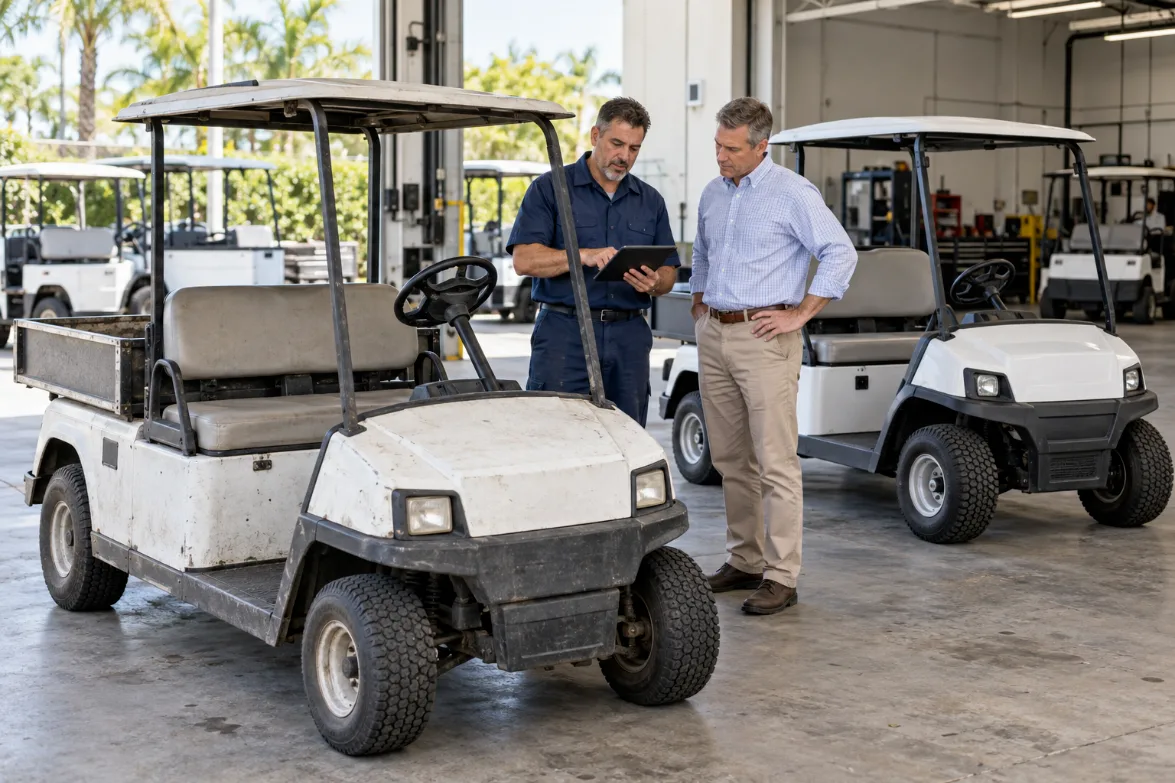
When a commercial golf cart or utility vehicle starts requiring frequent repairs, the decision is rarely as simple as comparing one repair estimate with the price of a new vehicle.
The better question is whether repairing that vehicle still makes operational and financial sense for the organization using it.
At GolfCarts Unlimited, we look beyond the immediate mechanical problem. We consider the vehicle’s overall condition, repair history, daily responsibilities, parts availability, downtime, safety, and whether it still fits the job it was originally purchased to perform.
Sometimes repairing the vehicle is clearly the right decision. In other situations, continuing to invest in it creates more expense and disruption than replacing it. There are also times when a vehicle can be repaired and reassigned to a less demanding role rather than removed from the fleet entirely.
The right decision depends on the vehicle, the work it performs, and the effect that downtime has on the organization.
Start With the Vehicle’s Role
Before deciding whether to repair or replace a commercial vehicle, we first need to understand what that vehicle does.
A golf cart used occasionally to transport visitors around a property has very different demands from a utility vehicle that carries tools and equipment throughout an eight-hour shift.
We look at questions such as:
- What job does the vehicle perform?
- How many hours is it used each day?
- How much weight does it regularly carry?
- Does it transport employees, guests, patients, equipment, or supplies?
- Is it operated indoors, outdoors, or in both environments?
- What terrain does it travel?
- How much disruption occurs when it is unavailable?
- Is another vehicle available to take its place?
A vehicle that performs a critical daily job may need to be replaced sooner than one used only occasionally, even when both vehicles are in similar mechanical condition.
The consequences of failure matter just as much as the cost of the repair.
One Repair Does Not Usually Mean a Vehicle Needs to Be Replaced
A commercial vehicle should not automatically be replaced because it needs brakes, tires, suspension work, batteries, or another significant repair.
These are serviceable vehicles, and normal wear should be expected.
If the frame and major systems are in good condition, parts remain available, and the vehicle continues to fit the operation, completing a necessary repair may provide several more years of productive use.
We do not believe organizations should replace vehicles unnecessarily. A properly repaired vehicle can remain a valuable part of a commercial fleet, especially when its repair history is known and it has been maintained consistently.
The decision begins to change when repairs become frequent, affect multiple major systems, or repeatedly interrupt the work the vehicle is supposed to support.
Look at the Complete Condition of the Vehicle
An individual repair estimate does not always show the complete picture.
For example, repairing a battery or charging problem may make sense if the remainder of the vehicle is in good condition. But if that same vehicle also has significant brake wear, loose steering, deteriorated suspension components, frame corrosion, damaged wiring, worn tires, and a history of recurring electrical problems, the organization needs to consider the combined condition of the vehicle.
That is why an honest evaluation should include more than the immediate failure.
At GolfCarts Unlimited, our service department looks at the vehicle as a whole. We want the customer to understand both the repair that is needed now and other visible conditions that may require attention in the near future.
That does not mean everything showing wear must automatically be replaced. It means the organization should have enough information to make an informed decision instead of approving one repair and being surprised by another shortly afterward.
Review the Vehicle’s Repair History
Service records can reveal whether a vehicle is experiencing normal wear or entering a pattern of recurring problems.
One repair may be reasonable. Several repairs involving unrelated major systems over a short period may indicate that the vehicle is approaching the end of its practical commercial life.
Questions worth reviewing include:
- How frequently has the vehicle been out of service?
- Are the same problems returning?
- Have several major components already been replaced?
- Is the organization continuing to repair one problem after another?
- How much has been spent during the last year or two?
- Are repair expenses increasing?
- Is the vehicle becoming less dependable even after repairs?
The total amount already spent should not be the only consideration. Money invested in previous repairs cannot be recovered simply by keeping the vehicle longer.
The decision should be based on what the organization is likely to spend—and what reliability it is likely to receive—going forward.
Consider the Cost of Downtime
Repair cost is only one part of the financial impact.
A vehicle that is unavailable may prevent an employee from completing work efficiently, delay maintenance, interrupt housekeeping operations, slow down material movement, or force another department to give up one of its vehicles.
In some operations, a vehicle being out of service for several days causes very little disruption. In others, even a single day of downtime creates a significant problem.
Organizations should consider:
- Employee time lost while waiting for a vehicle
- Work that is postponed or completed less efficiently
- The cost of renting or borrowing a temporary replacement
- Additional wear placed on the remaining fleet
- Delays caused by waiting for difficult-to-find parts
- The effect on guests, residents, patients, or customers
A repair that looks affordable on paper can become expensive when the vehicle repeatedly interrupts the operation.
Parts Availability Can Change the Decision
A vehicle cannot provide dependable commercial service if replacement parts are consistently unavailable.
We have seen the golf cart and utility vehicle market expand to include many makes and models. Some are supported by established manufacturers, dealer networks, technical information, and dependable parts distribution. Others can become difficult to repair once a particular component fails.
Before continuing to invest in an aging or unfamiliar vehicle, determine:
- Are replacement parts still being manufactured?
- Can common parts be obtained without excessive delays?
- Is technical information available?
- Are diagnostic tools required?
- Is there a qualified service provider familiar with the vehicle?
- Can the manufacturer or distributor provide support?
An inexpensive vehicle that sits for weeks waiting for a proprietary component may ultimately cost an organization more than a properly supported vehicle with a higher initial purchase price.
Parts and service support should be considered when purchasing a fleet, not only after a vehicle breaks down.
Safety and Structural Condition Come First
There is a difference between a vehicle that needs routine mechanical work and one with serious structural or safety concerns.
Frame damage, advanced corrosion, recurring brake problems, severely worn steering components, unreliable electrical systems, and improper previous repairs can all change whether continued investment makes sense.
Commercial vehicles may be operated by numerous employees with different experience levels. They may carry passengers, heavy tools, supplies, or other equipment. That makes predictable operation especially important.
A vehicle should not remain in a demanding commercial role merely because it can still be made to move.
If the cost of returning it to a safe, reliable condition is disproportionate to its remaining value and useful life, replacement may be the better decision.
Does the Vehicle Still Fit the Job?
Sometimes a vehicle remains repairable but no longer meets the organization’s needs.
The operation may have grown. The vehicle may now be expected to carry more equipment, travel farther, operate longer, or transport additional passengers. A vehicle purchased for occasional use may be performing full-shift duty that it was never intended to handle.
Before authorizing another major repair, consider whether the vehicle still has:
- The appropriate passenger capacity
- Enough cargo space and payload capacity
- Adequate range or operating time
- The right power source
- Suitable tires and suspension
- Necessary weather protection
- Proper lighting and safety equipment
- The durability required for its current workload
Repairing a vehicle does not solve the problem if it is fundamentally wrong for the work being performed.
In that situation, replacement allows the organization to select a vehicle that is better matched to the job.
Repairing and Reassigning May Be the Best Answer
The decision does not always have to be repair or replace.
A vehicle that is no longer dependable enough for a critical, high-use assignment may still be useful in a lighter-duty role.
For example, an older utility vehicle may no longer be the best choice for an employee who uses it continuously throughout the day. After appropriate repairs, it might still serve as:
- An occasional maintenance vehicle
- A backup vehicle
- Transportation for short trips
- A vehicle assigned to a lower-use department
- A seasonal or event-support vehicle
Reassignment can extend a vehicle’s useful life while allowing the organization to place a newer and more dependable vehicle in the role where reliability matters most.
However, the vehicle should still be safe, supportable, and appropriate for its new assignment. Reassignment should not become a way to avoid addressing a vehicle that has reached the end of its practical life.
Consider the Fleet as a Whole
Commercial replacement decisions should not be made one vehicle at a time without considering the rest of the fleet.
If several vehicles are approaching the same age and condition, replacing only the first one to fail may lead to a series of unplanned purchases and repairs.
A broader fleet review can identify:
- Which vehicles should remain in primary service
- Which vehicles need preventive maintenance
- Which vehicles could be reassigned
- Which vehicles should be replaced first
- Whether vehicle configurations should be standardized
- How future replacements can be spread across multiple budget periods
Fleet standardization can simplify employee training, service procedures, parts stocking, accessory installation, and future vehicle purchases.
That does not mean every vehicle must be identical. Different departments may require different configurations. The objective is to avoid unnecessary complexity while still matching each vehicle to the work it performs.
Organizations beginning that process can review our guide on how to choose the right commercial fleet.
When Repairing Usually Makes Sense
Repairing an existing commercial vehicle may be the better choice when:
- The problem is isolated and clearly diagnosed.
- The vehicle has otherwise been dependable.
- The frame and major systems remain in good condition.
- Replacement parts are readily available.
- The vehicle still fits its assigned job.
- Repair costs are reasonable compared with its remaining useful life.
- Downtime can be managed without significantly affecting the operation.
- The repair is expected to restore dependable service.
When Replacement Deserves Serious Consideration
Replacing a vehicle may make more sense when:
- Repairs are becoming frequent or unpredictable.
- Multiple major systems require attention.
- Downtime is interfering with daily operations.
- Replacement parts or technical support are difficult to obtain.
- The vehicle has significant structural or safety concerns.
- The existing vehicle no longer fits the job.
- Repair costs are approaching the value of a better-supported replacement.
- Fleet standardization would reduce future operating complexity.
- The organization no longer trusts the vehicle to complete its assigned work reliably.
None of these factors should be considered in isolation. The decision should reflect the vehicle’s complete condition and its importance to the operation.
Build a Replacement Plan Before a Vehicle Fails
The worst time to choose a replacement vehicle is often after a critical vehicle has already failed.
At that point, the organization may be forced to select whatever is immediately available instead of the vehicle that best fits its long-term needs.
A planned approach gives the organization time to:
- Evaluate the existing fleet
- Prioritize replacement needs
- Compare appropriate vehicle types
- Plan charging or fueling requirements
- Determine necessary accessories and configurations
- Standardize vehicles where practical
- Account for lead times and budget cycles
- Prepare employees for new equipment
Fleet planning does not require replacing every older vehicle at once. It means knowing which vehicles are likely to need attention next and having a reasonable plan before the operation is disrupted.
Let the Operation Drive the Decision
The purpose of a commercial fleet is to support the organization’s work.
A vehicle should be repaired when that investment can return it to safe, dependable, and productive service. It should be replaced when continued repairs no longer provide reasonable reliability or when the vehicle can no longer perform the job effectively.
In some cases, the best answer is to repair the vehicle and keep it in service. In others, it is to repair and reassign it. Sometimes replacement is the most responsible long-term decision.
GolfCarts Unlimited helps businesses, municipalities, educational institutions, healthcare organizations, hospitality properties, industrial facilities, property managers, and other organizations evaluate those choices.
If your organization is deciding whether to repair existing vehicles, replace part of its fleet, or develop a longer-term replacement plan, learn more about our commercial fleet solutions and consulting. We’ll take the time to understand your vehicles, your operation, and the work the fleet needs to support before recommending the next step.